Education Hub: Liquidity Pools on TON
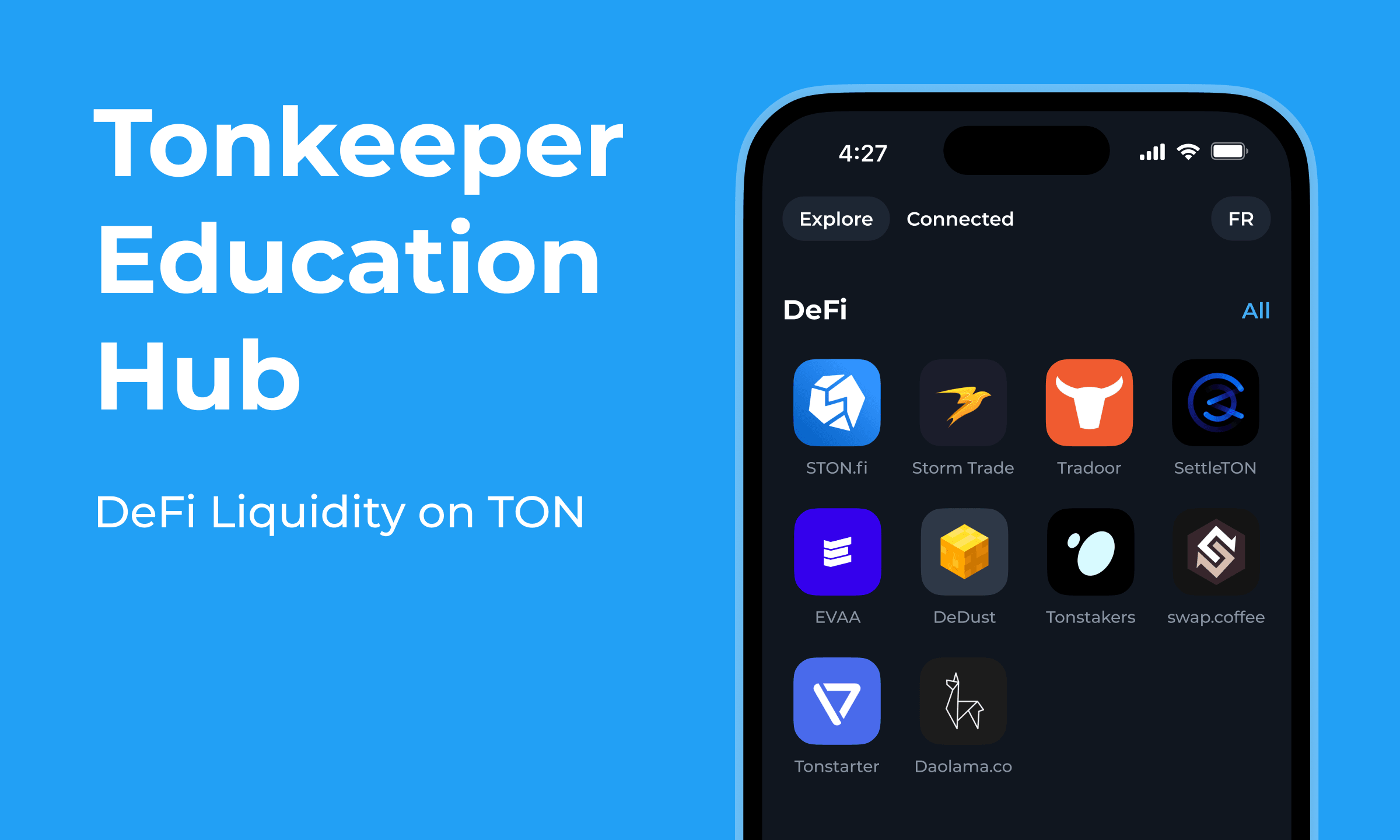
Liquidity pools are the engine of decentralized finance. They allow anyone to become a market maker — not just institutions — and earn a share of trading fees in return. On TON, this model is expanding rapidly: platforms like STON.fi, DeDust, SettleTON, and Tradoor each offer distinct approaches to providing and earning from liquidity. This guide explains how it works, what to watch out for, and how to access it all through Tonkeeper.
What Is a Liquidity Pool?
A liquidity pool is a smart contract holding two (or more) tokens that traders can swap against. Instead of a traditional order book where buyers and sellers must match, a liquidity pool uses an automated pricing formula — most commonly the constant product formula x × y = k, first described in the Uniswap v1 whitepaper — to price trades algorithmically based on the ratio of tokens in the pool.
When you deposit tokens into a pool, you become a liquidity provider (LP). In return, you receive LP tokens — proof of your share of the pool. Every time someone trades through that pool, a fee (typically 0.2–0.3%) is collected and added to the pool's reserves. When you withdraw, you redeem your LP tokens for your original deposit plus your accumulated share of fees.
Understanding LP Tokens
LP tokens represent your proportional ownership of a pool at the moment of deposit. They have three practical uses:
- Claim your deposit back — redeem them at any time to withdraw your share of the pool (original tokens + fees earned)
- Stake for additional yield — many platforms offer farming programs where staking LP tokens earns bonus rewards
- Use as collateral — some lending protocols accept LP tokens as collateral, letting you borrow against your liquidity position
Risks You Need to Understand Before Providing Liquidity
Impermanent Loss
The most important concept for any LP to understand. Impermanent loss occurs when the price of the tokens you deposited changes relative to each other after deposit. The further prices diverge, the more your position underperforms versus simply holding the tokens. A detailed explanation with examples is available in the Uniswap documentation — the math applies equally to TON liquidity pools.
The loss becomes "permanent" only when you withdraw at the worse ratio. If prices return to their original ratio, impermanent loss disappears. Stable pairs (e.g. USDT/USDC) have near-zero impermanent loss because both tokens are pegged to the same value.
Smart Contract Risk
Your funds are held by a smart contract, not a custodian. If the contract has a vulnerability and is exploited, funds can be lost. Before depositing, check whether the platform has undergone a security audit — this is usually published in the platform's documentation or GitHub repository. STON.fi, for example, publishes its audit reports in its GitHub repository.
Market Risk
The value of your position is denominated in the tokens you deposited. If both tokens fall in price, your position loses value regardless of fees earned. Start with pools containing established assets (TON, USDT) before providing liquidity to smaller tokens.
Liquidity Platforms on TON: What Makes Each Different
STON.fi
STON.fi is the largest DEX on TON by total value locked (TVL), tracked on DeFiLlama. It uses a standard AMM model with v2 pools that support concentrated liquidity ranges (similar to Uniswap v3), allowing LPs to concentrate capital within specific price ranges for higher fee efficiency. STON.fi also offers a farming program where LP token holders can earn STON rewards on top of trading fees.
DeDust
DeDust uses a different approach — Volatile and Stable pool types with its own pricing formula called CurveV2. Stable pools are optimized for assets that trade near a fixed ratio (like stablecoin pairs), reducing impermanent loss significantly. DeDust has its own governance token and offers liquidity mining programs. Its smart contracts are open source and available on GitHub.
SettleTON
SettleTON focuses on derivatives and structured products alongside standard liquidity pools. It adds options and synthetic exposure on top of liquidity — useful for more advanced DeFi strategies.
Tradoor: A Different Model for LPs
Tradoor is a perpetuals and options trading platform, which means its liquidity model works differently from a standard AMM. When you provide liquidity to Tradoor, you're acting as the counterparty to traders — not facilitating spot swaps.
Tradoor's LP mechanism includes several proprietary features:
- Price Lock — zero-slippage execution for traders, enabled by the LP pool absorbing price risk
- AI-powered Liquidity Shield — a risk management layer designed to reduce toxic order flow that would otherwise cause losses for LPs
- TLP tokens — Tradoor's LP token, redeemable at any time with no lockup period
- $DOOR points — an additional reward layer on top of fee income from trades, liquidations, and funding payments
LPs choose between TON and USDT pools. Fees are earned from perp trading, option premiums, and liquidated positions — not just swaps. Note: acting as counterparty to leveraged traders carries different risk than providing liquidity to a spot AMM. New users making their first trade on Tradoor through Tonkeeper receive $2 cashback.
How to Start Providing Liquidity Through Tonkeeper
- Open Tonkeeper and tap the DeFi section in the in-app browser.
- Choose a platform (STON.fi, DeDust, Tradoor, or SettleTON) and navigate to the Pools or Liquidity section.
- Connect automatically via TonConnect — Tonkeeper connects without exposing your keys.
- Select a pool based on the token pair and current APR. For beginners, TON/USDT pools on STON.fi or DeDust are the most straightforward starting point.
- Deposit tokens — you need both tokens in the pair. Confirm the transaction in Tonkeeper.
- Receive LP tokens — these appear in your Tonkeeper wallet and represent your position.
- Track your position — most platforms show your current share, fees earned, and impermanent loss in real time.
You can verify any transaction on Tonviewer. For ecosystem-wide TVL and yield data, DeFiLlama's TON page aggregates data across all major protocols.
This post is part of Tonkeeper's DeFi Education Hub. The information provided is for general informational purposes only and does not constitute financial or investment advice. DeFi involves significant risk including loss of principal. Consult a qualified financial advisor before making investment decisions.
Sources & further reading:
Uniswap v1 Whitepaper — AMM constant product formula
DeFiLlama — TON DeFi TVL and protocol data
STON.fi GitHub — open-source contracts and audits
DeDust GitHub — open-source contracts
TON documentation — DEX overview
Tonviewer — TON block explorer
Download Tonkeeper: tonkeeper.com
Download Tonkeeper Pro: tonkeeper.com/pro
Follow:
en ·
ru ·
فارسی ·
中文 ·
uz ·
twitter